

This page covers:
A fixed mindset can set in at any time. Learning to overcome it is crucial to success. That’s why a growth mindset must be both taught and actively practiced.
By using growth mindset language—framing failure as a learning opportunity—you can help your students earn higher grades, graduate on time, and stay on track for lifelong success.
Recognize your own fixed mindset
Think of something you used to struggle with, but you got better at through practice. Maybe it was learning to drive or using a new technology.
How about walking, talking, and tying your shoes? Those things come naturally now, after years of practice. But they didn’t at first. You worked hard for all your skills—and it paid off.
Every ability you have is the result of your effort, all the way down to learning to walk. Math, art, and other advanced skills work exactly the same way.
Remember that your thoughts about your abilities as an instructor, like any other area of your life, can fall prey to fixed-mindset thinking. Be open about your mistakes as a teacher, just as you expect students to be open about their mistakes. The willingness to experiment with new techniques and methods is an important part of having a growth mindset.
Address a student's fixed mindset
Imagine a student who grew up saying, “I hate math.” Not being a “math person” has become part of her identity.
Now she’s here at ASU, and she has to pass a math class to graduate. But instead of diving into the material and really trying to understand it, she memorizes whatever she can and hopes the tests will be easy. The difficult homework only proves that math isn’t for her. Every mistake makes her feel stupid. Math class becomes a place where she’s always being evaluated, instead of a place where she’s always learning.
By focusing on effort, not the outcome of a challenge, we teach students that it's okay to fail. Failure is a necessary part of the learning process.
If a student asks you about a bad grade, help them understand where they went wrong and how they can improve. Keep the setback from derailing them by talking through their next steps. Should they study more? Try a new technique? Collaborate with a classmate? Keeping the emphasis on effort will help support a student’s growth mindset.

1. Praise effort, not intelligence.
Practice and hard work should be the focus of your feedback. Instead of praising a student for answering a question correctly, praise them when they see a challenge through to completion, even if they made mistakes along the way or their final result wasn’t quite right.
Avoid implying that some students are born with natural abilities in a certain area. Such statements reinforce the false notion that talent can take the place of hard work. Success always requires effort.
If you tell a student she's smart for understanding a new idea quickly, what will she think when a concept takes her a while to grasp?
Challenge yourself to think about the feedback you’re giving. Keep track of how many instances of “fixed mindset” praise you give out. Here are some simple, effective substitutions:
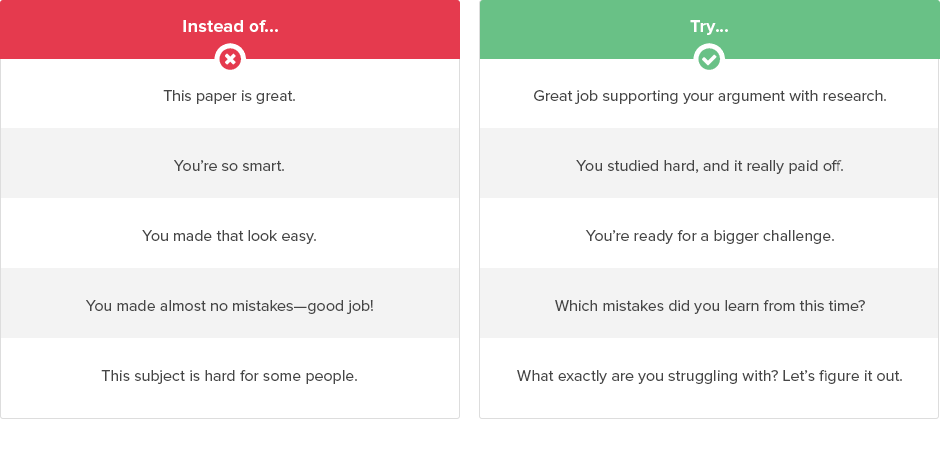
2. Set high expectations.
Tell your students that college is supposed to be tough—not to weed out the weak, but to make them stronger. Their classes may be difficult now, but the experience will help them master increasingly advanced subjects.
Encourage your students to reflect on their challenges and successes, either on their own or with a friend. This kind of self critique or peer critique can help students see how far they’ve come, as well as how far they still have to go.
Self critique and peer critique situations put the focus on the student’s progress, rather than the final result. Students often struggle with prioritizing their learning. Frequent, informal assessments can help point them in the right direction for what to focus on next.

In-class activity: Peer critique. Have your students reflect on their challenges and successes together.
3. Embrace mistakes.
Make sure your students understand that instructors expect them to make mistakes, not just in ASU 101 but throughout their time in college. Mistakes are a learning opportunity that should be celebrated. They help students and instructors identify areas that need more support.
Remind your students that when they’re making mistakes—scientifically speaking—they’re learning. Challenges make your brain stronger.

In-class activity: Lessons learned. Share your weekly "Lesson learned."